

How will your generosity help Good Shepherd Flourish in 2026?
People flourish at Good Shepherd. Full stop. You can witness this at church in many ways.
You can see it in the choir at our Madison campus. Jared Stellmacher has more than 50 people signed to sing on Sunday mornings on a regular basis, which is by far the biggest choir Good Shepherd has had this century.
You can see it through our Outreach programs. The Food pantry is serving more of our neighbors in need of food than ever before. 207 different volunteers helped the Holy COW serve more than 6,000 meals in 2025 at 72 different events. And more than 150 volunteers will help serve 500 meals to members and guests on Thanksgiving Day.
You can see it in Children, Youth and Family programming. 30-50 high school students are meeting bi-weekly for fellowship, which is the biggest the youth group has been at Good Shepherd in decades. We have 73 students registered at AMPED this year. Attendance is growing significantly at church school at both our Madison and Verona locations. And our engagement with parents of children baptized at Good Shepherd has jumped from 34% in 2023 to 85% in 2025.
All this flourishing is possible, thanks to the generosity of Good Shepherd members. We hope to receive commitments of more than $1.4 million from our members through our Flourish campaign this year. And thanks to your gifts, we are well on our way to reaching that goal.
Where do your contributions go?
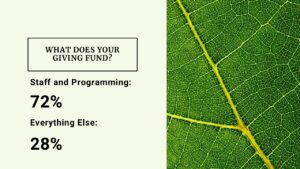
But what does your money actually fund? 72% of our budget goes to pay for programming and staff at Good Shepherd, and 28% goes to everything else. This percentage of our budget going to programming and staff is higher than most churches, but we look at this as a good thing. This means your generosity helps pay for quality ministries to help people flourish here. It also allows Good Shepherd to hire good people with good compensation to make that happen.
How has giving changed since we began eliminating our mortgage?
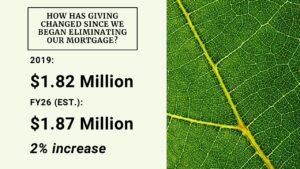
Back in 2019, Good Shepherd’s annual giving was $1.82 million. Over the past 6 years, Good Shepherd members have not only provided resources to keep all our ministries going, but they also helped us eliminate a mortgage that was more than $3 million dollars at the end of 2019. In addition, giving held steady throughout the COVID-19 pandemic, when members were unable to enter either sanctuary at our Madison and Verona campuses for nearly a year.
Fast forward to 2025. Our estimated giving for this upcoming fiscal year is $1.87 million, or an increase of 2% over 2019.
Shouldn’t eliminating the mortgage give us more money?
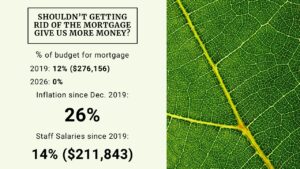
Back in 2019, we spent $276,156 total on mortgage payments, which accounted for 12% of our total spending in that year’s budget. In 2026, we will not spend any money on our mortgage. That’s great news. Good Shepherd now has more financial flexibility. But it doesn’t mean the church has an extra $276,156 to spend.
Why? In one word – Inflation. Since December of 2019, inflation in the United States has gone up 26%. That’s a much higher percentage than the 2% increase in giving we’ve received over the past 6 years. That means the costs of running Good Shepherd has outpaced our giving. Inflation has affected Good Shepherd two ways:
- Salaries – Staff salaries at Good Shepherd have increased 14% since 2019, or about $210,000 a year. That means the church has not been able to provide our high-quality staff raises that keep up with the cost in inflation. Yet, that increase alone has eaten up more than 75% of the savings we received by eliminating our mortgage.
- Everything Else – The cost of everything else needed to run Good Shepherd in FY 26 has gone up 23%, or about $103,000 a year. Combined, those two numbers exceed the $276,156 we spent on the mortgage in 2019. But in both cases, percentage wise, the increases were lower than the rate of inflation during that period.
What has happened to our givers since 2019?
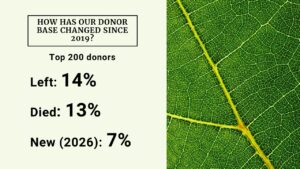
Another major change since 2019 is who gives to Good Shepherd. In both 2019 and 2025, approximately 80% of our total donations came from our top 200 donors. Since 2019, 14% of our top 200 donors have left Good Shepherd. They’ve left for a variety of reasons. Some have found new spiritual homes elsewhere in Madison. But many of these donors have simply moved out of the area, including several who moved to be nearer to their children and grandchildren, which is not uncommon.
In addition, 13% of our top 200 donor families have experienced a death in the family since 2019. This is also not extremely high, especially in 2025. However, that means more than a quarter of our top givers in 2019 are no longer here.
The best way to address this generosity issue is to find new members to replace the members who are no longer with us. In 2026, 7% of our top 200 donors are people who were not members of Good Shepherd in 2019. That is a good sign…but it doesn’t replace the 27% who are not here anymore.
What is needed for Good Shepherd to Flourish in the future?
Are people flourishing at Good Shepherd in 2025? Absolutely. The giving provided by our members has led many programs to thrive this year. To continue this success, we’re encouraging donors to prayerfully consider increasing their giving to Good Shepherd. The goal of this year’s Flourish campaign is an increase of 3.58%, which is close to the annual inflation rate over the past year. If we increase giving at that rate, it will likely increase our giving by approximately $50,000, which will allow us to continue to offer the same high-quality worship and music offerings, children, youth and family programming, and robust Outreach programs Good Shepherd is known for.
However, groups like the Interim Task Force have spent the past year identifying issues that need to be addressed at Good Shepherd in the near future. They include an inventory of all the maintenance needs over the next 20 years. The report calls for the church to spend $2 million over the next 20 years. However, because the church has put off necessary maintenance for the past few years as we tried to eliminate the mortgage, $1.5 million of that spending is scheduled to be done over the next five years.
In addition, Good Shepherd has started a Verona Site Pastor Transition Team to address the growing need for services near our Verona campus. The amount of housing being created in the three miles between our Madison and Verona campus has skyrocketed since 2019. In addition, Good Shepherd’s large corporate neighbor to the west, Epic Systems, has added more than 4,000 workers since 2019, an increase of 40%. If Good Shepherd hires more people to serve our members and welcome new ones, there will be a need for more resources to pay for both the staff, and the infrastructure around them.
Can Good Shepherd grow its giving to address the needs of our community?
The challenges Good Shepherd will face to increase its giving to meet the needs of its members and its community are substantial. The church may need to increase giving by 15-20% over the next three years to meet that need. But Good Shepherd has successfully addressed financial challenges before.
In the late 1990’s, Good Shepherd identified a need for growth on the northside of Verona. And thanks to its members, Good Shepherd created a Field of Dreams, where a large new campus was built back in 2003.
In 2019, Good Shepherd had to find a way to reduce the $3 million dollar mortgage. Thanks to disciplined, sustained giving over a five-year period, members were able to eliminate that mortgage and enjoy a debt free future.
Our next challenge has been identified. How are you going to help Good Shepherd address the needs our church to allow the church to flourish in the next 3-5 years?
